
Grand Prairie City Directory Collections
Grand Prairie does not have one confirmed municipal directory shelf that covers every year. The strongest named run is the UT Austin Briscoe Center's telephone-directory citation, supplemented by a Grand Prairie criss-cross finding at the Library of Congress and broader Dallas-area residence volumes. Treat these as telephone, residence, or address directories, not as a single official roll of city residents. The ROOTS Room is a practical local stop for files that can corroborate a directory hit, although its page does not identify a specific Grand Prairie city-directory shelf run.
| Collection | Years | Where Held | Access |
|---|---|---|---|
| Grand Prairie Telephone Directory | 1918-2005, with listed gaps | UT Austin Briscoe Center citation | Online citation and collection reference |
| Greater Dallas Residence White Pages | 1957-2010, with gaps | UT Austin Briscoe Center citation | Area-wide reference, not city-only |
| Grand Prairie criss-cross finding | 1966 | Library of Congress directory inventory | Directory finding aid |
| Texas city-directory materials | Varies by volume | Texas State Library and Archives | Print or microform in the Austin reading room |
The Briscoe sequence includes March 1918, March 1919, February 1922, January 1924, January 1931, then a later run through April 2005 with breaks between listed editions. Publisher names change from Southwestern Telegraph & Telephone to Southwestern Bell and SBC, and area codes shift among 214, 469, and 972. A missed year may simply be a gap in the surviving citation, so do not turn an absent listing into a conclusion.
Grand Prairie Telephone Directory Run
The UT Briscoe citation for Grand Prairie telephone directories is the clearest place to establish whether an edition exists before looking for a name. Its coverage is Dallas and Grand Prairie, so a listing belongs to that edition's stated service area rather than proving a municipal boundary. That scope matters when a street or postal label crosses county and city lines. Use the closest date first, then check the neighboring available issue if a family seems to appear or disappear abruptly.
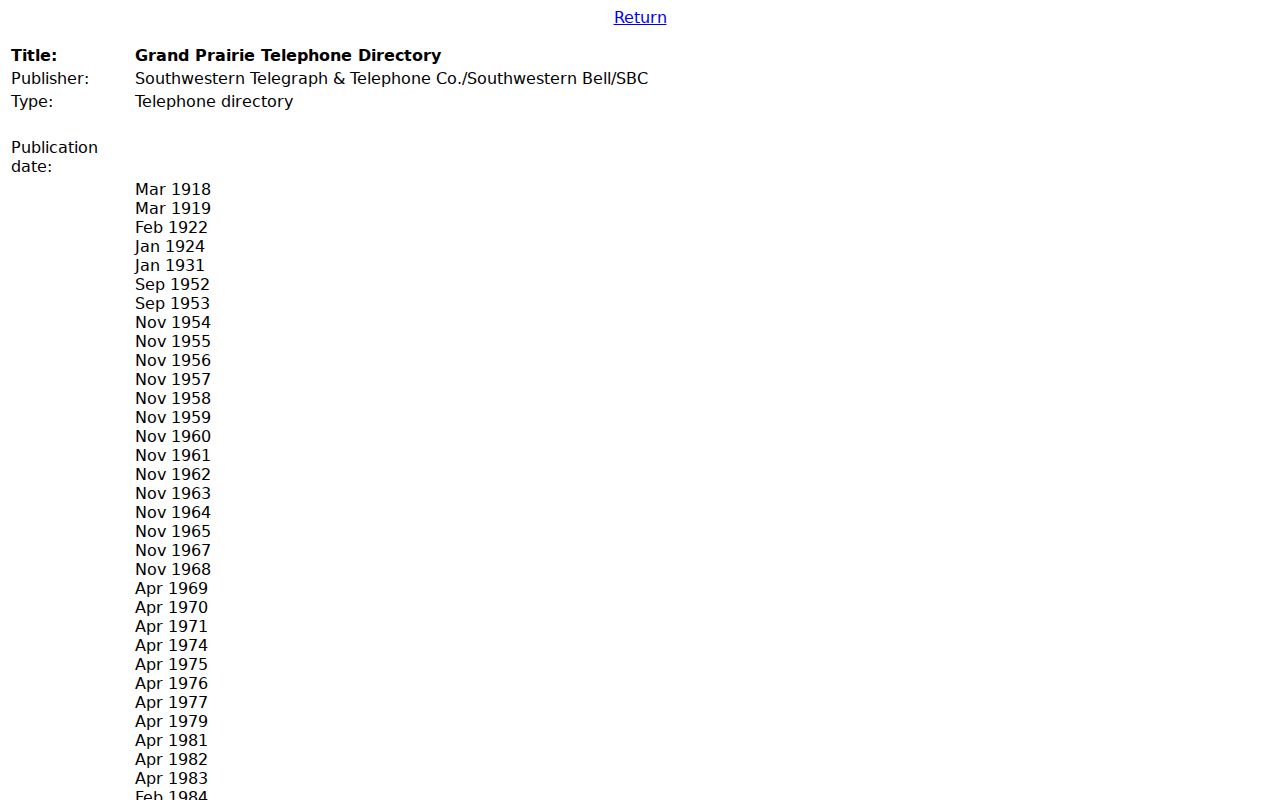
The citation view is useful for choosing a year and recognizing gaps before a reader commits to a longer archive search. It also keeps the label precise: this is a telephone-directory run, not proof that every Grand Prairie household was included.
For a broad comparison, the Greater Dallas Residence White Pages span 1957 through 2010 with gaps and include Grand Prairie among several communities. A name or address there deserves a second source, especially when the same street could be associated with a larger Dallas-area delivery pattern.
Grand Prairie Criss-Cross Directory
Alphabetical listings answer a name-first question. A criss-cross directory adds an address-arranged path, which is useful when the street is known but the household is not. The Library of Congress guide to criss-cross directories identifies a Grand Prairie, Texas, entry for 1966. That is a specific local finding, not a guarantee that the guide supplies all years or every page of the edition.
- Criss-cross directory
- A directory arranged to support both name and address reading. Use its address side to find the entry tied to a particular street in that edition.
- Householder index
- An index that groups a household or address when an edition includes one. Confirm the volume's own heading before assuming it has this feature.
- Abbreviation key
- The volume's explanation of its shortened labels. Read and save that key before interpreting an unfamiliar entry.
Record the edition date, the arrangement used, and the exact address as printed. An address-order entry is still a dated directory observation. It should not be stretched into a claim about later occupancy or ownership.
Grand Prairie City Directories at ROOTS
The ROOTS Room at the Grand Prairie Main Library is the local fallback when an online search ends with a gap. Reference genealogy books are non-circulating, closed reference and archive items are retrieved by a librarian, and digitized material is viewed on a reserved genealogy computer. Three free computers are available, printing carries small charges, and the library recommends bringing a USB drive for digitized material. Ask staff whether uncatalogued or caged directory material exists rather than assuming a shelf run from the website.
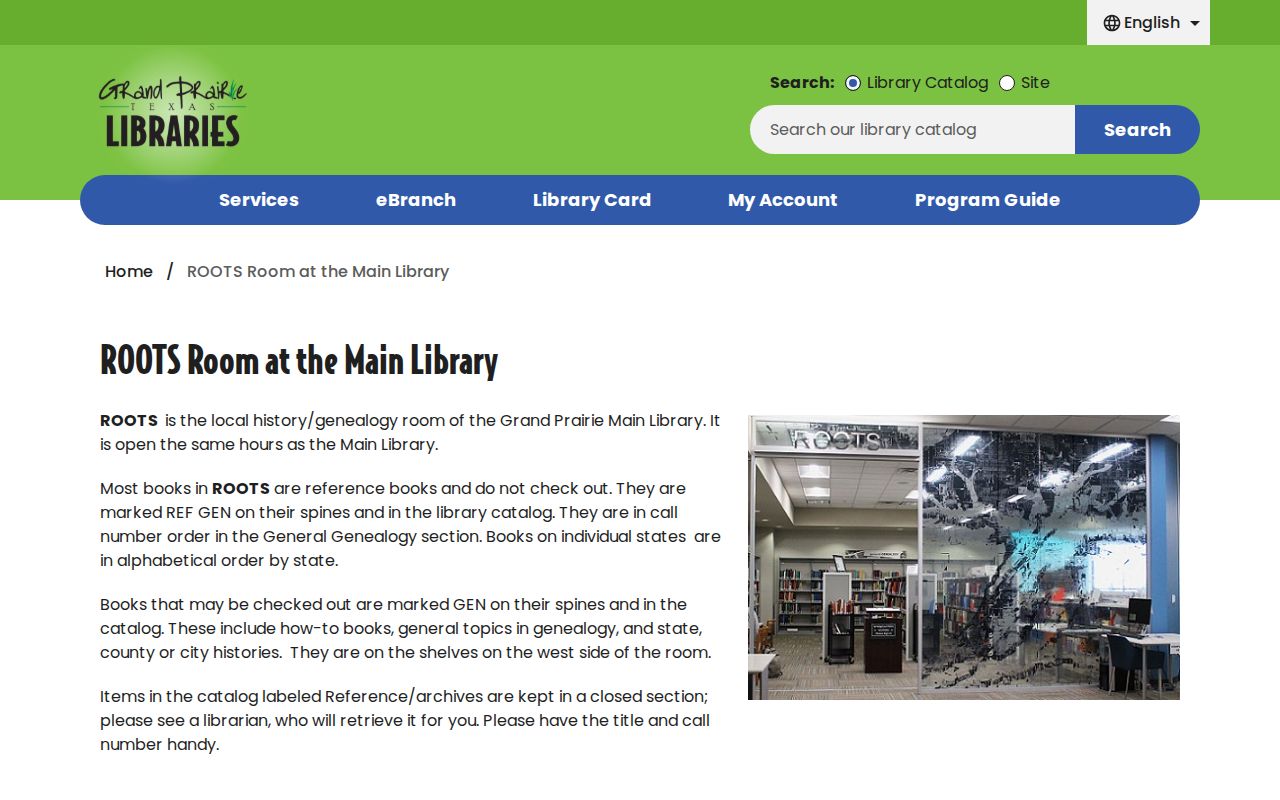
ROOTS also holds local newspapers, yearbooks, city scrapbooks, tax lists, landmark files, clippings, photographs, and reference books. Those neighboring sources can test a directory lead without claiming that the library's web page confirms a particular city-directory volume.
Reading a Grand Prairie City Directory Entry
Begin with the parts an edition actually displays. The UNT city-directory collection describes directories that can include names, addresses, phone numbers, business listings, indexes, and advertisements. These fields vary by publication and date. A clean research note separates what was printed from what a later source may suggest, and keeps the edition date beside the transcription.
| Printed name | The spelling and initials used in that edition. Compare variants in the next available volume. |
|---|---|
| Street address | The address as printed, including any old number or street form that needs later map comparison. |
| Telephone detail | A telephone number or service-area clue when the edition provides one. |
| Arrangement | Whether the reader found the item through an alphabetical or address-arranged section. |
| Edition evidence | The title, year, page, and abbreviation key needed to revisit the finding. |
The entry is a lead, not a verdict. A telephone directory may omit people, carry an old address, or use a name form that differs from a deed, tax list, or family paper. Preserve the page image or a careful citation before moving to another source.
Grand Prairie Directory Gaps
Local newspaper coverage explains why a name trail sometimes stops. ROOTS lists the Grand Prairie Texan for several periods, but its holdings have a conspicuous 1938-1952 gap. The Daily News Texan begins in late 1958 and becomes the Daily News in July 1966. A missing mention during a gap is a collection limit, not evidence that a family, address, or local business was absent.
Check adjacent years, then use the Arlington Star Telegram Grand Prairie sections or Dallas Morning News Grand Prairie sections where their runs fit the period. Tax lists can also anchor a name to a neighborhood: Grand Prairie lists include 1913-1960, 1963-1965, and 1968, while Dalworth and Dalworth Park have separate runs. Historical tax presence is a dated lead, not current ownership evidence.
Grand Prairie City Directory Companions
When a directory gives only a name and address, the Grand Prairie Historical Organization can add local context. Its museum and archive room has photographs, objects, vertical files, and GPISD yearbooks. The reviewed listing gives a 1516 W Main location, free entry, Monday through Saturday hours of 1 to 4, a Sunday closure, and a volunteer-run archive. Call 972-639-3388 before relying on an in-person visit because volunteer availability can change.
The Historical Organization museum page identifies the archive setting and its local collections.

A vertical file or yearbook can corroborate a place and period around a directory entry. It should be cited for what it says, while the directory remains the source for its own address-arranged or alphabetical listing.
Grand Prairie City Directories Household Trail
A household trail works best when each source has a clear task. Start with an available telephone or residence directory near the year in question. Preserve the printed address, then compare the next available issue rather than assuming there was an annual volume. If the address appears to change, inspect the criss-cross arrangement when the edition offers it and compare nearby landmarks or street forms. The larger address-record chain belongs in the Grand Prairie street directory.
- Choose the closest verified edition from the Briscoe citation or another named collection.
- Copy the printed name, address, page, year, and any abbreviation that affects meaning.
- Check the next available edition and the address arrangement, if present, for a move or a name variant.
- Pair the dated address with a ROOTS tax list, newspaper run, yearbook, or local-history file that covers the same period.
- Use a deed or parcel source only to test property history, keeping ownership evidence separate from a directory listing.
Grand Prairie Genealogical Society is another local bridge. The group says volunteers digitized city tax rolls from 1913 until the county took over in the 1970s. Its cemetery project is a volunteer record with continuing burials, so it can support a family-history trail without becoming a complete local register.
Grand Prairie City Directory Map Bridge
Directory text can be paired with a map when an old address no longer fits a current parcel. The Library of Congress holds a November 1929 Grand Prairie and Dalworth Sanborn set with nine sheets, while UNT has a 1920 Grand Prairie sheet. Both can show buildings, streets, and land use. Neither identifies the person who lived at a location.
Use the printed directory address to select a likely block, then compare the map's street and structure clues with local files, tax lists, and later records. The Grand Prairie streets map service can help connect a modern address to an address point, parcel lot, county, or city-limit layer, but it is a geographic context source, not an identity record. This careful split keeps a building history from becoming an unsupported household claim.
For a number that seems to disappear, the city's 911 Addressing guidance explains that addresses within city limits are assigned after a parcel is legally platted and filed with the county. It also distinguishes a physical-address change from a mailing-address change. Compare the historic directory form with the recorded plat and parcel context before deciding that two differently numbered records concern different places.