
Finding Grand Prairie Residents
Grand Prairie has no universal public roster. The useful route depends on whether you have an address, a name, or a past year. First, use the city parcel and address layers to check the county. Then use that county's appraisal district and clerk records. A deed can establish that an instrument was recorded, while an appraisal card identifies a tax account and a historic directory records a dated household listing. These are separate kinds of evidence.
Start narrowly and preserve the source date. A parcel can sit in Grand Prairie while its appraisal, deed, court, or registrar record belongs to Dallas, Tarrant, Ellis, or Johnson County. A name hit alone is not enough. Pair it with an address, date, instrument number, or another independent match before drawing a conclusion.
- Check the Grand Prairie GIS streets and address service for the address, parcel context, city limits, ZIP, and county layer.
- Search the matching appraisal district by address, account, or owner. Keep the situs address and mailing address as separate fields.
- Use the applicable county official-record index for grantor, grantee, instrument, date, or legal-description leads.
- For an earlier household, ask the ROOTS Room or a named directory collection for the correct year and edition.
- When an agency record is not online, use its stated counter, mail, or records-request channel rather than assuming it is unavailable.
Grand Prairie Resident Record Custodians
Grand Prairie resident records are held by different custodians. The city assigns and maps addresses, county appraisal districts maintain property accounts, county clerks keep official-record indexes, and the Texas Secretary of State operates the voter lookup. Dallas County is one route, not the default for every address. The address-by-address sequence requires a street-level record trail.
Grand Prairie GIS and Addressing
City Hall, 300 W Main St
Grand Prairie, TX 75050
972-237-8000
Dallas County Clerk
Records Building, 500 Elm St, Suite 2100
Dallas, TX 75202
214-653-7099
Texas Voter Records
Statewide registration-status tool
County and identity fields required
Use the official portal
Dallas County offers its own index and clerk contacts. Tarrant, Ellis, and Johnson parcels need their respective county clerk and appraisal district. Confirm that jurisdiction before ordering a copy or using a court record.
Grand Prairie County-Line Check
The city is a four-county records problem. Grand Prairie's FY2025 financial report identifies Dallas, Tarrant, Ellis, and Johnson counties, while a city neighborhood page names Dallas, Tarrant, and Ellis. That difference is a reason to verify the parcel, not to choose one description and ignore the other. City limits, ETJ, mailing labels, and county records do not always follow the same line.
For a property question, begin with the city GIS layer, then open the applicable CAD account. Dallas addresses can use DCAD's address search; Tarrant has its own appraisal and GIS viewer; Ellis and Johnson each route through their own CAD. A Grand Prairie mailing address alone does not select the right clerk or vital registrar.
Grand Prairie Parcel Search Fields
DCAD provides the clearest captured address form for the Dallas County portion of Grand Prairie. Use one number for an exact address or a From and To range. Enter a direction only when it belongs in the street address. The street-name field needs at least two characters, omits the street type, and accepts a percent sign as a wildcard. Reduce the fields when a tight search fails.
| DCAD Field | Entry Type | Search Note |
|---|---|---|
| Number | Required text or number | One exact number, or a From and To range; no suite letters. |
| Direction | Optional dropdown | Use the directional part of the street where applicable. |
| Street Name | Text | At least two characters; omit street type; percent sign supports a wildcard. |
| Building and Suite | Optional text | Useful for multi-unit records when the form permits it. |
| City and Account Type | Optional selection | City can narrow results; select residential, commercial, or BPP as needed. |
The DCAD address-search screen shows those fields. Its results are appraisal leads, not deed images and not proof that a person occupies the address.
The Dallas CAD address search illustrates how Grand Prairie residents directory research begins with a parcel rather than an assumed household. The form separates address work from a name search. That distinction matters when a property has a different mailing city.
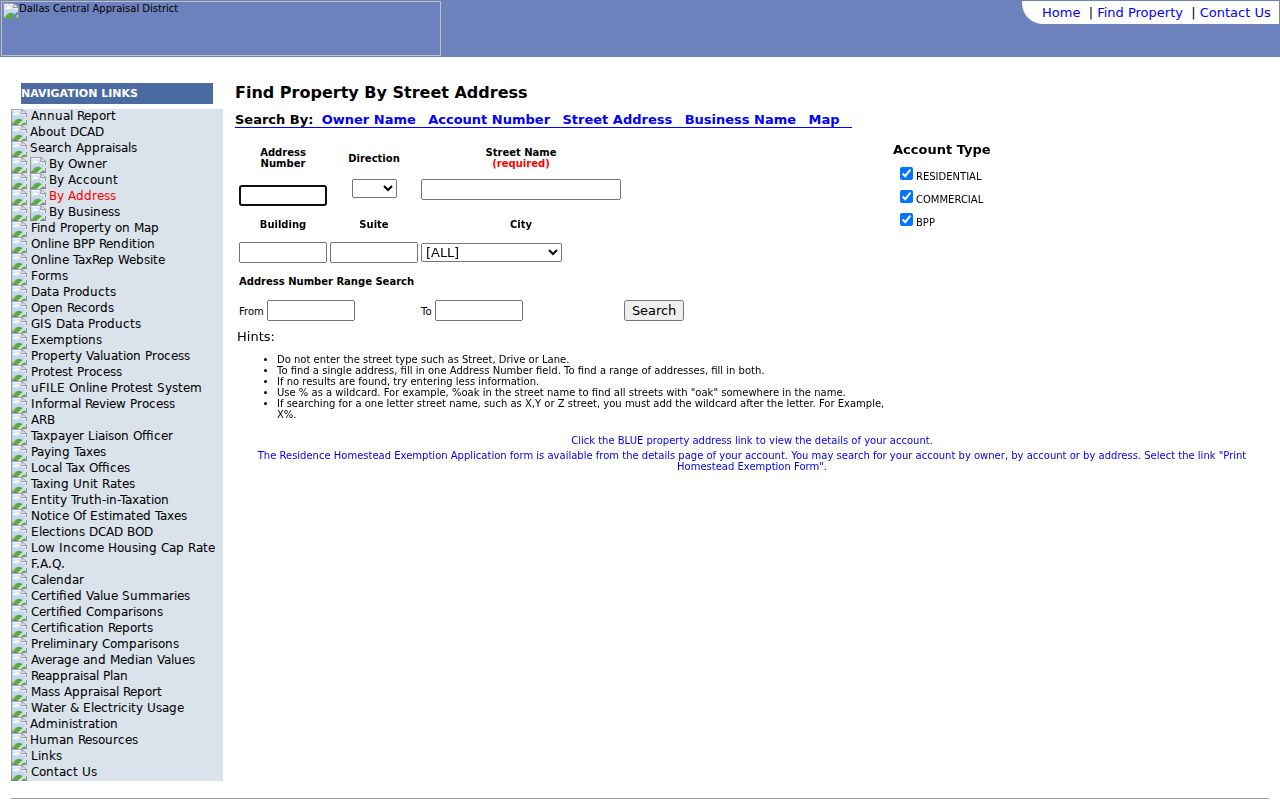
The captured form makes the number, direction, street-name, building, suite, city, and account-type choices visible before a search is run.
Grand Prairie GIS Context
City GIS is the right first stop when the question is geographic. Its street service includes address points, parcel lots, buildings, streets, counties, parks, water, and city limits. The Information service adds ZIP Codes, ETJ, schools, libraries, floodplain, public-improvement districts, and other civic layers. These layers can establish physical context without turning a map into a people list.
The parcel layer exposes a GIS link, street number, name and type, city, city-state-ZIP value, address, coordinates, and polygon geometry. Use those fields to compare a normalized address to a CAD account. Do not treat an address-point match as a person match. The current street directory expands the address record chain only when the reader needs that level of detail.
Current Grand Prairie Resident Sources
Current sources establish different things. An appraisal account can show an owner field and a situs address. A deed index can identify the parties to an instrument. Texas voter tools confirm a registration status within their stated privacy rules. The city HOA directory is voluntary association context, not proof that a named officer or contact lives in a subdivision.
| Source | What It Can Confirm | Custodian | Access Route |
|---|---|---|---|
| GIS address and parcel layer | Address, parcel geography, boundaries, civic context | City of Grand Prairie | Free GIS service |
| County appraisal account | Tax-account owner field, situs, legal description | Applicable CAD | CAD portal or map |
| Official-record index | Parties, instruments, recorded documents | Applicable County Clerk | Online index, counter, mail, or copy route |
| My Voter Portal | Registration status, VUID, polling place | Texas Secretary of State | Official lookup with identity fields |
| HOA directory and map | Voluntary association and subdivision context | City of Grand Prairie | Directory or interactive map |
A one-person question needs a source trail, not a bundle of loose matches. The Grand Prairie resident lookup page keeps that verification workflow separate from address and historical searches.
Grand Prairie Deed Record Trail
After the CAD identifies a county and legal description, use the county clerk's official-record index. Dallas County's official portal supports research by name or instrument number and directs users to e-Certify for a digital certified document when one is available. Its paper request route is still useful when a digital record is unavailable. That route requests clues such as grantor, grantee, instrument number, document type, and property address.
Tarrant's index has a different captured interface: real-property scope, search term, recorded-date range, image filter, and index-only or index-plus-OCR full-text modes. Its clerk offers online, in-person, and mail copy paths, and says it does not conduct title or lien searches. Read the instrument itself before relying on an index entry.
Dallas County's official-record index is a Grand Prairie residents directory source for recorded party names, not a complete current-residence list. A search page gives the starting point; an image or certified copy supplies the actual document context.
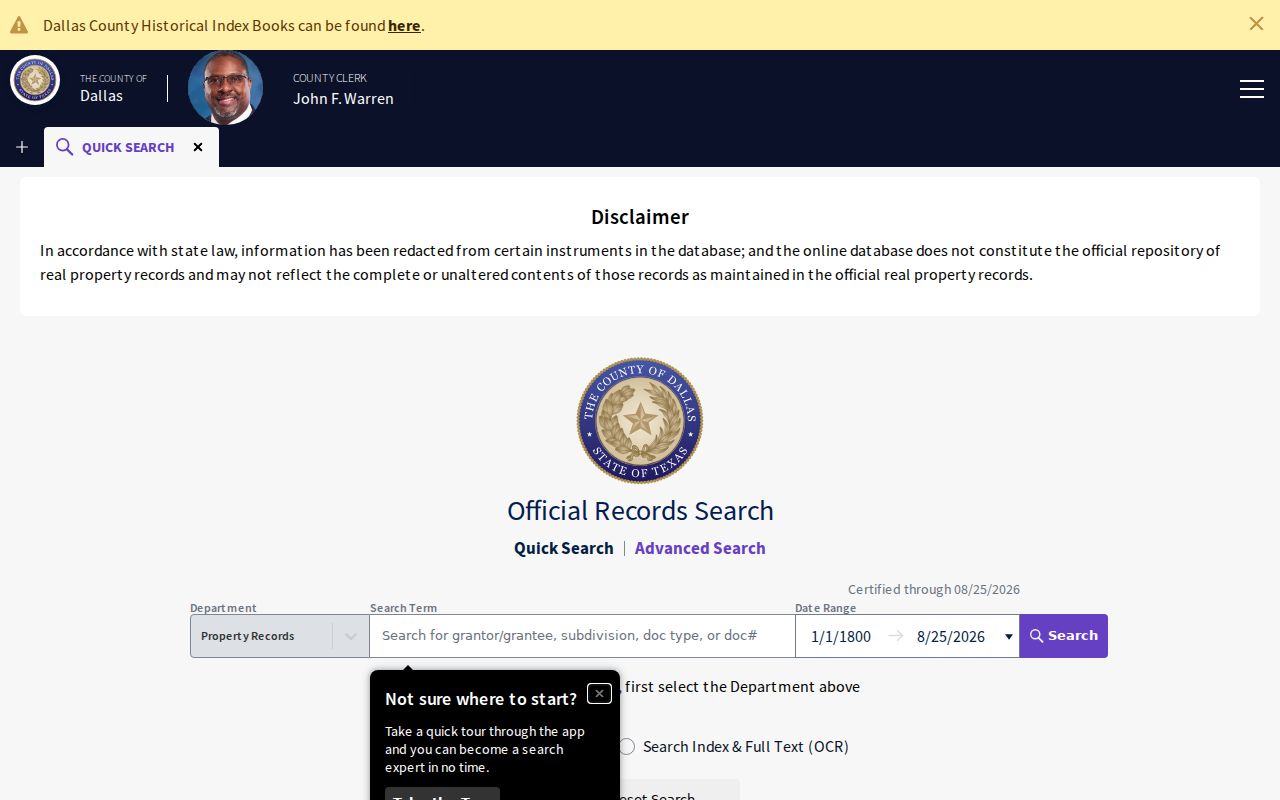
The Dallas capture is a reminder to search by the county of the parcel and to preserve the record number before ordering or reviewing a copy.
Grand Prairie Voter Privacy
Texas My Voter Portal has a limited role in Grand Prairie resident research. Official guidance describes paths using a VUID, Texas driver license plus date of birth, or a name with county and additional identity fields. It can return registration status, VUID, and polling-place information. It is not a public current-address directory, and a status match does not prove someone is physically present at an address today.
Texas law treats voter fields differently. How a person voted is not public, and residence address, Social Security number, Texas driver license or personal-identification number, and protected-address categories have restrictions. Ask the elections custodian about a lawful, record-specific request rather than copying restricted fields from a screen.
Texas My Voter Portal is the official place to confirm the limited status information it provides. The source must be checked on the date of search because screen fields and privacy settings can change.
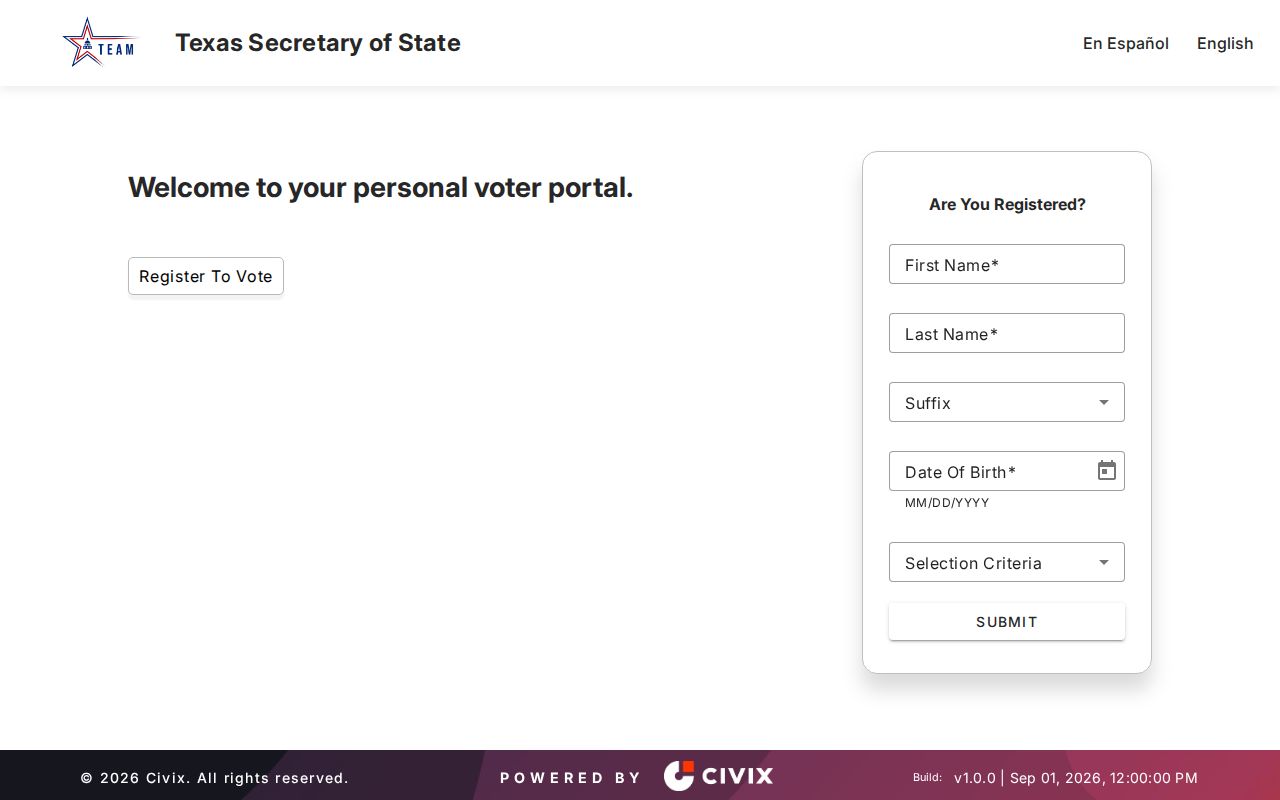
The capture shows a state service designed for registration verification, not a broad Grand Prairie residents directory export.
Grand Prairie Court Records
Court sources must match the court. Grand Prairie Municipal Court has a citation and warrant search for citation or warrant number, driver license number, first and last name with date of birth, or license plate. Its notice says a basic name search can return limited information and a warrant status is not a finding of guilt. County, district, appellate, and federal matters use different clerks or systems.
For Dallas County civil and family matters, the District Clerk's online case information reaches back to 1975, with most civil files online after 2008 and specified ranges in person. Texas has no single trial-court portal. If a record is missing, use the clerk for the court holding it rather than assuming the person or case does not exist.
Grand Prairie Municipal Court provides the court's contact and citation information. Search only the record type needed and retain the court, source date, and case or citation reference.
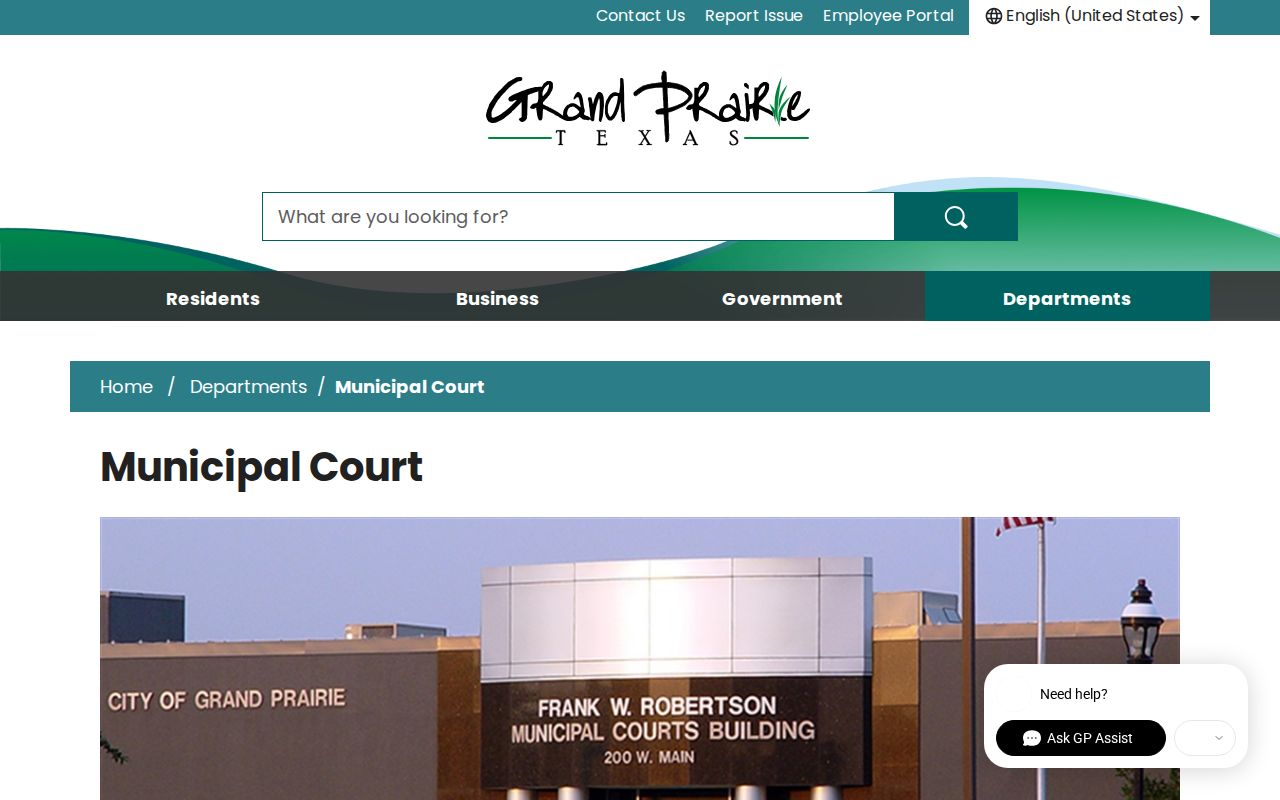
The municipal court capture points to a case-specific route, which should not be used as an identity or resident-list shortcut.
Grand Prairie Vital Access Dates
Vital records have a different public boundary. Under Texas Government Code Section 552.115, birth records become public after 75 years and death records after 25 years. Recent records require the eligibility, relationship, identification, or direct tangible interest that the local registrar or Texas Department of State Health Services requires. An index entry is not a legal certificate.
Texas public marriage and divorce indexes begin in 1966 and 1968, respectively, but they are not comprehensive and cannot replace a certified record. For an event in the Dallas County portion outside the City of Dallas, the County Clerk may be the local registrar. For any other event, first confirm the event location and then use the appropriate local office or the state route.
- Roll
- A list or account created for a specific public purpose, not an all-resident file.
- Index
- A searchable pointer to a record. It may omit the document image and can contain variant spellings.
- Parcel
- A mapped tract or lot used in land and tax systems; it is not the same as a household.
- Criss-cross directory
- An address arrangement that can help place a historical listing on a street for a particular edition.
Grand Prairie Historical Directories
Grand Prairie's strongest historical resident sources are not a single municipal directory shelf. The ROOTS Room at the Main Library has newspapers, yearbooks, tax lists, city scrapbooks, landmark applications, local-history files, photographs, and digitized materials. Closed reference and archival materials are retrieved by staff, and digitized material uses a reserved genealogy computer. Bring a USB if the library asks you to save material that way.
The UT Briscoe collection identifies Grand Prairie telephone directories from 1918 through 2005 with gaps. The Library of Congress inventory has a Grand Prairie criss-cross directory for 1966. Those dated editions are useful snapshots, while the Grand Prairie city directories page identifies the shelves and the missing runs in more detail.
Grand Prairie Archive Gaps
A missing name is often a collection question. ROOTS holdings show that the Grand Prairie Texan has a 1938 through 1952 gap, while the much shorter Grand Prairie Hustler run spans 1904 through 1906. Early Grand Prairie tax lists begin in 1913, and Dalworth, Dalworth Park, and delinquent lists have their own periods. Neighborhood names are useful search keys rather than interchangeable labels.
Use a gap as a routing signal. Check an adjacent directory year, Arlington or Dallas newspapers, the tax lists, or an official record in the county that held the parcel. A historical directory entry supports a date-specific listing. It does not prove a permanent residence or resolve same-name people by itself.
Grand Prairie Public Request Routes
When the needed city material is not posted, the Texas Public Information Act is the request path, not a guarantee that every field is open. Texas treats records as presumptively available but permits confidential material to be withheld and allows a cost estimate when charges exceed $40. A useful request names the department, record type, date range, parcel, case, or instrument number and asks for the preferred format.
Grand Prairie's current public-information instructions state that, effective September 1, 2026, requests may be sent through its online route, by email, by mail to the City Secretary, or in person. Police-record requests use a different GPPD Records Division route. Confirm the current instructions immediately before sending a request because the city has announced this process change.
Grand Prairie public-information request instructions list the current channels and the police-records handoff. A narrow request is easier for an agency to route and easier for a reader to verify.

The city capture connects records requests to the correct custodian when a portal or archive does not hold the needed material.